Friday, 3 August 2012

In search of Persia: Persian Gulf

Journal Entry 4/11/2011
Bander e Abbas 
Persian Gulf Iran.
Bander e Abbas The Hormuz straits  between the Arabian Sea and the Gulf
Our day started with the Usual breakfast of boiled egg, goats cheese, flat bread washed down with copious amounts of tea sweetened to distraction. A word on the restaurant. This room had 2 metre ceiling brightly painted giving the feeling of it falling in on you. Mate fair dinkum gave us indigestion eating those hard boiled cold eggs with a mosaic on our heads. 


Some background: Bander Abbas is situated to the South of Iran. It affords deep water access to the Amman Sea and the Indian Ocean for Iran. Strategically situated at the narrowest point on the straits. Through here 70% of the worlds oil supplies pass. There is an added threat from terrorists from Saudi and Yemen. 
Map of Bander e Abbas
The port area where we were staying is a smugglers paradise. This is big business, hi speed catamarans painted black run the the Straits.  
We figured it was not a savory place to loiter.
Our aim was to visit the historic Qeshm Island the Abu Dhabi of Iran. A Tax free Zone.


I know, you'll say "what in the heck are you doing there"?


Fast air conditioned Ferry to Qeshm Island
Ferries to Qeshm Island are modern and fast but there is one big catch. If the weather gets up the ferries stop. Problem!  We had a plane booked out of Bander Abbas for Shiraz and time was fast running out. Our aim was to visit ethnic villages where the traditional Arab Dowhes are made and repaired. This boats design has not changed for hundreds of years. It plys the trade routes as far south as India. Our curiosity was piqued and we were keen to see the villagers and the ship yards. Citt had an interest in the Bander people. (Bander meaning coastal) They look like Arabs but with  Iranian traditions and the men dress in pure white clothing. The women wear colorful masks and bright clothes. Adorned with  lots of golden jewelry and bling reminiscent of India.
Local Bander girl and Citt in our hotel
The history of this place is colorful all world colonial powers have had a go. The Arabs, Portugese, English, Russians and of course the French. Reminders of past eras mark the waterfront points, ruined forts, gun emplacements and now Chinese stinger missiles. It is as flat as a pancake with little or no vegetation devoid of trees.(It was peaceful during our brief stay).


There I go again getting away from our journey In search of Persia.
We walked out of our hotel into a sticky hot morning with rain threatening, On our way to the ferry we noticed a man in a suit pulling a suit case. We did not realise that over the next 3 days Hojat Sallamallahahzscleh was to be very real in our lives. Arriving at the ticket office Hojat helped us to buy our airconditioned ferry ticket and showed us the way to the boat. 
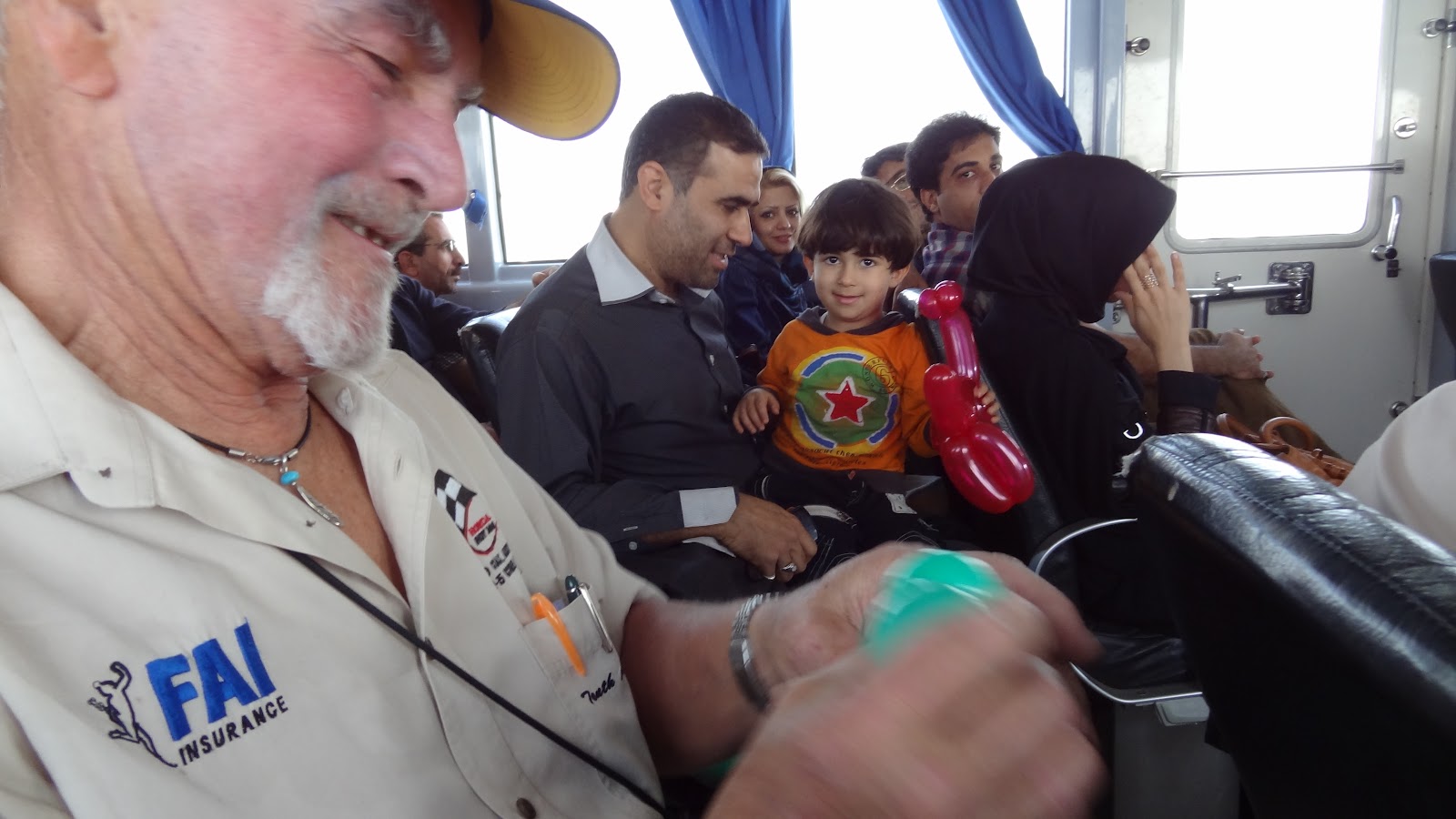
Little kid waiting for his balloon and Mr Twisty
We both  had fun on the boat me Mr Twisty and Citt with meeting and inadvertantly interviewing without record people, information on the outside world in return information about their lives the  country its government and the current problems.
Arriving in port Hojat found us and asked us the usual where are you staying and how long. He invited us to join hi in his limo and we set off to find a hotel. The place was chokkers, He invited us to stay at his apartment. We were suspicous and reluctant to take hospitality from a complete stranger, given the dodgey area we felt really uncomfortable. In the end he took us to a relatives new hotel on the outskirts of town,
Our Hotel Queshm Island
All well and good, so we thought. We settled in and changed to a nonsmoking room. Citt was not well having picked up a flu on the bus. I ventured downstairs to enquire the cost of our accommadation and was politely told. "you are the guests of the Mr Hojat Sallamallahahzscleh owner of the  fish factory. A car will be here tomorrow to show you around the island and visit the fish factory for lunch. There is no charge for this hotel, you are our guests. So please rest and enjoy. There is tea in the kitchen for you".
We were amazed at the hospitality of this man. (In hindsight most of the Iranians we met were hospitable. They told us it was the custom of the land to welcome travelers and strangers. We heard tales of their land and the problems with the extremist government).  I am a balloon artist and loved having fun with the kids. Citt is a good ambassador and professional interviewer. 
He must have reckoned we were very, very good Aussies. He got that in one.  :)
We enjoyed the hospitality and the friendship offered. We were to find out he was influential and rich. But that is another story.


Over the next day.
We rested and looked forward to our visit to the fish factory and a tour of the island. Citt was not well.  She had collected a virus and was run down after a huge 14 days traveling. The hotel was quiet and comfortable. We only ventured into the town for internet contacts and food. The town was awful. Someone in Tehran had stuffed up if they thought this would be a rival to Dubai. The food was a mixture of Arab and Iranian. Fish was on the menu. Our taste buds had tired of Kebab. !!!
The view from the fish farm.
Journal entry Sunday 6th November 2011  The car arrived early to take us to the farm and an island journey. It looked like a big day.


The fish factory was an eye opener. The trawlers were contracted boats with full crew from Thailand. Hojat told us he was negotiating for 10 Chinese boats to enlarge his fleet.  The catch is small blue eye fish at a depth of 250 meters. They turn these little 2cm blue eyes into fish meal for the fish farms. The factory sits high on a cliff overlooking the straits of Hormuz. The horizon features gas platforms in the sea with huge flames coming from the burners. At the time of our visit the factory was having flash freezers and kitchens installed to maximize the extra catch, shark and fish to fillets for domestic markets. Value add.
Citt our Benefactor  Hojat Sallamallahahzscleh
Me and the Manager Hakan
Our benefactor owned fish farms, chicken farms and orchards. 


After a great meal and chat through interpreters we were taken to the bus station for our journey around the island.
Local camels. 
The sand castles
The island is a long sliver of sand with a UNESCO listed mangrove forest. 
Mangroves and Citt
The main attraction is sand castles and old smugglers caves cut out of the sand which is like a soft sandstone.  The island has very little rain. 
Local tourists

Citt makes friends with the locals
As always we met and talked with groups of locals and Iranian tourists. 


Journal entry Monday 7th
The day looked like being stormy and windy. We were apprehensive of our chances of getting back to the mainland and our flight to Shiraz and worse, Citt's visa had one day to expiry.  We were to extend in Shiraz.  Time to move on but first we must visit the boat yards down the far end of the island at a village called Luft and catch a ferry to Bander e Abbas. We hired a taxi for the 3 hours trip to Luft and back to the boat harbour.


Scrapping the hulls before applying anti foul.
Typical Dhows
 Luft Village is situated on the far northern tip of the island. It has large tides ideal for servicing the hulls boats.
Luft water catchment area showing cistern full of water at the time of our visit.
Air conditioning tower Persian style
The local lady with mask
  1. The Persians perfected airconditioning.  They build towers on their houses loaded with water. These suck the hot air out and recirculates with cool air. I have added an image of these ingenious devices for you. No electrical power needed.
  2. The water collection system is a series of channels draining into deep wells and these in turn are connected to a main cistern. The whole system is gravitational.
  3. Eucalypt trees are everywhere providing shade and excellent charcoal. So our Ozzie export is a true achiever. 
  4. The story of the ladies in masks is an interesting one. The mask was introduced by the Portuguese in the 1500s as fashion accessory. It stuck and today the women wear all sorts of different Gucci designs.  The shador is a recent innovation bought on by the fundamentalist regimes in the middle east.
The main business of this village is boats, boat builidng and repair. The yards were all closed due to the holiday. 
Our driver waited for us as we walked and explored. The locals were not friendly in this place - very suspicious. It was to be understood given the bloody history of this region.
The trip back to the wharf was a quick one as I suspect our driver was training for the Dacca rally or maybe the F1. Anyway he did himself no favors as we had negotiated a rate on time. 

The ferry terminal was in a frenzy as only half the boats were making the trip. This is where I saw Citt do her thing. She single handed got us on a boat within 15 minutes via the water police. It was a performance to cheer. 
When we settled down after me jumping on the boat over the void as the boat was on its way  due to the fact Citt would not leave without me. Giving the crew her best outburst. That's my girl!

Back at Port.  Bander E Abbas 6 hours to the flight. Everything in this town was shut tight. So we headed for a 5 star hotel. Taxi to the airport and the biggest security check of my life before being admitted to the terminal. We flew at 2300 hours.

Next journal entry 
Shiraz - Persepolis
Yazd -Central Desert
Journey-end Tehran


Tuesday, 24 April 2012

In search of Persia: Esfahan and the central desert


Journal entry Sunday 29 - 31 October
Citt and I found our luxury unit at the hotel Hash Behest, Esfahan to be just too comfortable. We stayed for 3 days making good use of the time to wash our clothes, book air fares and eat some yummy food.
Sharastan Bridge with obvious places for coffee and Chaikanna houses now banned in Iran,
This one is in the river bed. I do not think it is too permanent.
Esfahan has a large Christian population - Armenian Lutheran who came here for work during construction of the many mosques and public buildings. They are skilled workers, stonemasons, artisans and ceramic workers and they stayed. The area on the South of the river is the Armenian section. One afternoon we set out to walk to this section, on the way visiting and crossing the Sharastan Bridge, one of the many bridges over the  Zayandeh River. It was dry when we were there. (A sad indictment of the ruling regime. It is said they have dammed the river to feed orchards owned by the members of the ruling junta).
The walkway on the bridge or promenade empty of musicians and poets.
Sadly the Chaicannas have closed by decree.
The walk was long and interesting passing through the Bond Street and Park Lane of  Esfahan. The Christian Chuches were closed however after a meal in a good Armenian restaurant Citt went shopping. Now Citt does not often go shopping but when she does it is a sight to see. The poor shop assistant that gets her attention is put through the hoops. In short she purchased a beautiful original silk scarf for a song. "I think they were glad to get her out of the shop".
Journal entry Sunday 31 October
Bus from Esfahan to Kerman.
I should have been more aware on the bus from Hermansham to Esfahan  to the hidden peril of the guy in the front seat, hacking and coughing, broacasting his germs.  I was to get a flu making me pay big time.
The journey from Esfahan to Kerman is across barren desert country.  The road is divided highway with a speed limit enforced, 110kph.


Huge ceramic factories easily 2 hectares each dot the plains.  Road trains carry loads of tiles heading to Italy, Germany, Russia and who knows, maybe Australia.
The bus is express 9 hours with only one pee stop. Of course the police stops are mandatory. It is not the road to travel if you have drunk too much water.
On arrival in Kerman we had the usual argument with the taxis. Taxi drivers throughout the world are always trying to charge double or triple. It is 'look out wood duck'. 
Truck heading for Pakistan/Iran border. Great sign writing.
So here we were in a nice comfortable hotel in Kerman.  
We set about hiring a guide and a car. 
Our goal
  1. Travel to and sleep in the desert at the Koluts (Sand Castle), (5000 star hotel) 220 kilometres out on the desert road to Afghanistan 
  2. Visit the ancient oasis’s  
  3. Explore  the “Ganuts” underground water channels dug over 2000 years ago to supply water to oasis and caravanserai’s that serviced and sheltered the caravans travelling on the Silk Road from India and Central Asia
  4. Visit the Bagh-E Shazde (Shahs Garden) at Mahan, a small town south of Kerman. It was reputed to be famous for opium production prior to the Revolution.
  5. Travel to the ancient city of Bam. Pivotal point of the Silk Road with one of largest Arg structures (castle/fort made of sand and mud) in the world. That was until  5.30am December 23, 2003. When the whole city was devasted by an earthquake, 6.8 on the richter scale directly under the city. Today it is reputed to be the largest adobe construction site on earth listed by UNESCO.
  6. We did not want to go further than Bam as it is too close to the Pakistan border for our safety. Kidnapping is common south of Bam in the border areas.
  7. We will then ride a bus and travel to Bander Abbas situated on the Persian Gulf to visit the Bander people.
Goals set now find a guide.
Me at the Kaluts
Next day our car  (yellow taxi all loaded) just fitted us in.
Citt with our taxi to the Kaluts
Our guide supplied the gear. Two sleeping bags and ground sheet. He had his trusty cooking pot along, Plus some other stuff to make tea and store things. Off we go.
Camping Iran style (Kaluts)

The Kaluts (Sand Castles)
The Kaluts and a desert Caravanserai.
The Kaluts live up to their reputation. They are like Monument Valley in the US, only carved out of sand. We arrived on dusk. Slept most of way as I was a sick puppy.
The sand kept getting up my nose
Citt at the Kaluts
The road takes us through  barren mountains with pockets of fertile lands in the valleys. Emerging into the desert is awesome with flat land as far as the eye can see. There are oasis on this desert and I was intrigued how the water came to these areas. 
Oasis
Date palms and vegetable patches grew fed by streams The stream turned out to be an engineering feat called a Ganut. Tunnels dug by engineers starting 2000 years ago and still active today. 

Daily Chores on the Ganut
The ancient citadel in the oasis.
Our night at the Kaluts was sleeping out in bags.  The wind was strong and we buried our heads in the bags. The morning dawned clear and bright. Citt and I took photos and enjoyed the moment. On the way out of the desert we visited an oasis and investigated the Ganut feeding the village.
The Ganuts. First find a reliable water source in the mountains (50kms away) then dig the tunnels at an average depth of 8 metres. A manhole is dug approx every 10 metres. The water is gravity fed.
The Ganut diggers are still active today.
We found the same technology in Tulafan in the area near Urumqui in the northern Gobi desert China.
Our journey to Hamay we visited the Princes garden and the old citadel at Ronay
The Shahs gardens
The Shahs garden at night made even more spectacular as it is in the desert.
 before heading finally to Bam into which, to our disappointment, we arrived in the dark. Bam was completely destroyed by an earthquake in the last few years it has risen from the ashes with new steel framed modern buildings. Unesco is supervising the rebuild of the old Citadel. 


We saw little of the place and it seemed pointless to drive all the way down here and only see an outline.
As a bonus our guide took us to meet a friend of his who lost all in the quake. He told us of the nightmare and the heartache the quake had created. He lost 18 family members that morning. Those that survived the quake, but were trapped in the debris, froze to death. 
The town is suffering as the overland route used to go through here from India. The Afgahn war has stopped the flow and the tourists (local)do not come to view the magnificent Citadel which we were told was perfect and the largest in Iran.
But the tourists will return once the Citadel is completed.

It was late as we headed back toward Kerman stopping for dinner at the Shahs Place and then a onto a hotel.
The Shahs palace
The next morning we traveled back to Kerman and jumped on a bus and headed straight for Bander Abbas on the Persian Gulf. (9 hours)


Dhows on the Persian Gulf

Next a fishy story and a flight to Shiraz


Monday, 16 April 2012

Hiccup on the road of life.

Hello and gooday.
Hello mates "I have been crook" as we say in Aussie.
I thought it time to correct a Hernia. Result of an earlier cancer operation. Here's me thinking it would be a quick in and out of hospital, Wrong again  the first operation  went pear shape and the surgeon had to go in and repair the repair another operation.  
Painful & expensive. Difficult for my family with a new baby due and Citt coming home to be here for the birth. 
Our mate Jo Hassan made me biscuits in the shape of red shoes.  Just to cheer me up.
But all is well now we have a beautiful grand-daughter. Citt has returned to "our world" and I am at last feeling good,


"Absolutely fabulous"  now we can resume our journey in Iran. The next leg is written and I will post in the next day or so.


Hope you are fine wherever you are. 
I had a great time on the net while I was crook and loved this clip. 
If it offends some just turn it off 
I like it as it is uplifting and taking the Micky out of establishment,


Life of Brian.
http://youtu.be/WlBiLNN1NhQ


Next Post
Travelling from Esfahan to Kerman/Bam/Bander Abbas (on the Persian Gulf)