Showing posts with label Turkey. Show all posts

Saturday, 17 December 2011

In search of Persia" >Border crossing Iran

Journal entry 21 October 2011


Today was the day we had dreamed of. We were going to Iran to search for the sites of ancient Persia and to savor modern Persian lifestyle.
Citt my traveling companion on this journey (our youngest daughter)
and I traveling on the bus. Maku to Tabriz Iran,


(Persia is derived from the Greek word Persis. The area was called Persia by the Greeks in 330BC)


I hope you can understand our trepidation on this day. 
The media paints Iran as a terrorist state ("part of the axis of evil")*  We are given to believe that all Iranians are terrorists and we could be shot, held hostage, or even put in jail. 


The always question - why are you going there. It was easier to say, "going to Turkey",  or in some cases evade the question. The reasons are easy and in hindsight we can look back and say that was a good idea. There is no reason not to visit a country as to me people are basically decent. They love their kids and still have to put the rubbish out on Friday.  
I said to Citt 'No photos in no mans land' but she took this one anyway. Turkish-Iran border.
Rules exist for journeys "to places less trodden". It is wise to stay away from areas of civil unrest, armed conflicts, shady corners and dark alleys. And of course Mum's advice "not to speak to strangers" is out the window. Apart from that, let it all hang out.


Persia (Iran)
The historical significance of Persia is huge.
The earliest man lived here 10,000 BC and from there it all happened. The Empire of the Persian was founded in 728BC by Cyrus 559BC-529BC) The most impressive thing about the Persians is the long history of civil rights and freedom of speech. It is ironic the present regime is so repressive when throughout the Achaemenid Dynasty 559BC until Alexander the Great 330BC all men were treated equal in a bill of human rights. 
I am Cyrus (559BC - 529BC) the Great who founded the Empire of the Persians.
Grudge me not therefore this little earth that covers my body.
The Persian Empire dominated Mesopotamia from 612-330 BC. The Achaemenid Persians of central Iran ruled an empire which comprised Iran, Mesopotamia, Syria, Egypt, and parts of Asia Minor and India. Their ceremonial capital was Persepolis in southern Iran founded by King Darius the Great. 
Persepolis was burned by Alexander the Great in 331 B.C. Only the columns, stairways, and door jambs of this great palace survived the fire. We plan to visit this palace later in our journey.
Darius relief Persepolis Iran    
(Image Citt Williams)
The empires.
The Medes          
728BC - 330 BC
Aechaemenid Period (the golden age of Persia)
530BC - 330BC
Hellenistic Period (Alexander the Great)
330BC - 312BC 
Seleucids
312BC - 238 BC
Parthians
170BC - AD226
Sassinads
AD226 - 650
The coming of Islam (Arab)
AD650-1219
Mongol invasion and occupation
AD1219-1500
The Safavids and a new enlightened Persia
AD1500-1722
Persia and European influence
1722-1914 "The great game". Britain, France and Russia.


Since the first world wars, Iran has become a political football due to the fact it is the top producer of oil and gas in the world. Azerbaijan (was a part of Iran) has been the top producer of quality oil for 125 years. Hitler tried to control this in the 2nd world war and the Russians resisted in the famous battle of Stalingrad depriving the Germans of much needed oil for the war machine. Known as the Eastern Front it is estimated 30 million souls perished in this conflict between 22 June 1941 and 9 May 1945.
http://www.historyofwar.org/Maps/maps_stalingrad1.html
Through the back door May 1941
The Germans then tried to put a pincer on the allies through the Greece peninsular and Crete to land in Lebanon but the British and the Anzac forces foiled that one in the battle of Crete 1942. The allies lost this one but in the meantime won the war. It is not well documented but this battle was the most critical in the course of the war as Hitler lost all of his elite corps to the Anzac forces on Crete.  Most of the surviving allied force was taken POW (estimated 5,700) however The New Zealander Mauri corp at Heraklion Crete repelled the glider attack. The Mauris subsequently were the most feared by the German troops. A band of Australians and Kiwis escaped into the hills and became guerilla forces. 
The battle of Crete
There is a stark reminder at Horas Phakion on the south Crete coast the final place the allies evacuated by sea (submarine and destroyers). There was a glass case in the main square dated 1942 with every male head from the village with a neat hole in the skull. This was a warning to the locals not to assist the allies. (Pam, Kellie-Ann and I lived on Crete for 3 months in 1974 traveling in a camper. There was more than random acts of kindness from the locals). 


It is ironical that today Europe the US and its allies are still toying with Iran. Like the Germans before them oil is all important to their economy. (Please bear in mind the Iranians nationalized all of the assets of France England and the US in the 60s. It is little wonder the government and people of Iran are angry and they may have weapons of mass destruction. The Israelis have them and no-one is calling them evil? 


It is a bit like the small kid in school who has all the lollies and the big kids have none. But the little kid has a Taser and has found out how to use it.


There is a saying in this part of the world. 
Never tell an Iranian what to do! You could get hurt.


Forgive me I am getting away from the Iran story/blog but it all has a bearing on history and my thoughts when entering Iran.


Useful reading in a simple form.
http://www.crystalinks.com/persia.html


The ancient silk road led to Tehran, Tabriz and Shiraz on its winding way to Baghdad, the Mediterranean ports of Antakya and Anatolia, then onto Egypt and Africa. Trading wares from China in the East to Egypt and Europe in the West from early BC to modern 1900s.
Today highways are being built by China across the grasslands of Central Asia to take over where the ancient traders left off. Replacing camels with huge Scania and Chinese road trains.


Crossing the border 21/10/11
The day dawned clear and bright. We were so happy as that meant we could get a good look at Mt Ararat and maybe get an image for you. 
Mount Ararat Turkey
The dining room on the fifth floor roof of the hotel had a surprise for us. We met some Dutch cycle tourists en-route around the world in Erzurum Turkey and here they were munching on bread, cheese and honey. Inspirational people.  One of the guys has a prosthetic leg and the others are 50+.   Sold the lot to take an adventure. Why not?
They were stuck waiting for the customs to clear some spare parts for their bikes. Shit happens. 
The dining room on the fifth floor. One Dutch cycle tourist.


Saying our goodbyes we hoisted our packs and headed off to find our mini bus for the 20 minute ride to the Iran border. Our hope was to meet these intrepid travelers again in about 18 months. They are scheduled to be in our part of the world the beautiful Gold Coast Australia.


Border crossings are never my favorite pastime. (I remember in the 70s crossing with Pam and Kellie-Ann into Syria. It cost us Deutchmarks and a bottle of alcohol to get through) and it was expected this may happen here. 
But no such thing. 
Mini Bus to the border


We arrived at the border and changed some Turkish money to Iranian Rial. We of course got fleeced. Turkish money is useless in Iran.  
It is very confusing.
Iranian currency $1 = R11,050  
The currency is all in notes and comes in R500-R500,000 
10,000 rial (A$1.10) Front
20,000 rial (A$2.20) Back
We changed near $200.00 and the stack did not fit into my top pocket or my bag. The most annoying thing is the R10,000 ($1) note is the same color as the R100,000 ($10) caused some problems for me later on.
The real story of the crossing starts after the very civil border guards ushered us into Iran. 
Citt had put her scarf and head band on (her Iran outfit as she called it), as she must. She was so nervous as we walked out of the customs hall.


Then the pond life got hold of us.....


We still had a 100 Turkish Lire which we changed with one of the moneychangers. At a discount as always but that is business for these guys. 
Then the fun started our bus to Tabriz was in a town called Maku some 85 kilometers away and time was not on our side as we understood the last bus left at 13.00 and it was near 12.00. The mob got hold of me and tried to wrench my bag from me demanding R50,000 ($5) for the taxi ride. 
(Citt left me to it and watched at a respectable distance with a bemused look on her face. 
She said "that it was not a woman's place in Iran to argue with a man". We were to find out later that is not the case at all, but that is another story).  
I was getting nowhere as I realized that the fare was over the top by double and there was no way I was going to pay that sum of money. Then all of a sudden a motor bike wheel pushed into the crowd and a big muscly guy with a strong english accent addressed me. (Citt calls him Robo-Cop)  
Q> Where was I from? 
Who was I traveling with? 
Where did I want to go?
What is my business in Iran? 
He took it all in and then told me simple rules for traveling in Iran. He then told me how to deal with the mob. THEN he took to the mob in Farsi. They all stood there with mouths open. I am sure in hindsight he was berating them for treating a stranger and a guest in their country so badly. The mob were silent. He then revved up his very large mountain motorcycle and was gone Pooof. 
Me> I walked out of the crowd and walked to Citt. She could not stop laughing. Loves a drama........ (:
Yellow cab Iran style


I did as he said and walked to a yellow cab and guess what R20,000 to Maku. In Maku I did it again and there was another Robbo Cop as the bus was full but we got on thanks to these strangers. 
On the bus to Tabriz Iran


The rest of our journey these people with random acts of kindness were to be called.....
Angels.

* George W Bush President of the United States of America In his State of the Union Speech 29 February 2002; 
President Bush labelled Iran, Iraq and North Korea "The Axis of Evil".  describing these governments of helping terrorism and seeking weapons of mass destruction. 
History has shown Iraq had no weapons of mass destruction but a lot of oil. it took 100,000 local lives to prove him wrong plus 4,483 US dead and 33,00 wounded. This official tally is reputed to be incorrect. 

Monday, 5 December 2011

Van, Tombs, Snow, and a fateful decision.

17th October 
Urfa-Dayakbakir -Dayakbakir-Tatvan
Local buses 10 hours
Map of Turkey our journey so far.

This leg of the  journey takes us from the desert to the mountains-cape of southeastern Turkey. 
We had planned to go straight to Lake Van but we heard there were some spectacular historic grave sites on the Northern side of Lake Van. So after a fairly uneventful Journey on the bus we stopped in the town on Tatvan on the lakes of Lake Van. 
Tatvan at dawn with storm clouds threatening
The hotel was 70s style with eco friendly lights,  so friendly we needed a torch to read anything.

 On the side we were going to go for an evening stroll to look at the town, 5 minutes into the walk we both felt that maybe it was not a good idea. The streets were filled with testerone fueled young guys. We retreated to our hotel. It is the first time we felt any danger We were warned by the Polis earlier not to walk at night and not to go down alleys. 
Good advice. 

It rained all night with the promise of snow. We felt the cold after the deserts. 
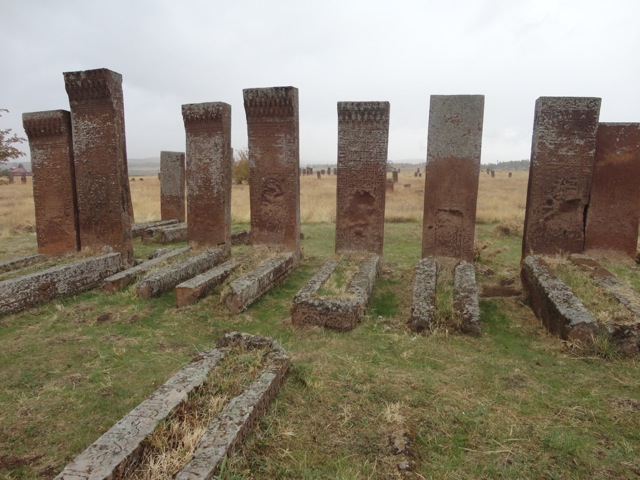
After a spartan brekkie in our 70s style hotel that looked like an hospital. We grabbed the  mini bus for a 30 minute ride to Ahlat Museum miles from any where but right on the Historic tombs dating from 300AD Byzantine, Greek, Seljuk, Chinese Greek Armenian and Turkic tombs. 
Seljuk Tombstones 

The Museum adjacent was smal but very well done. 

Armenian grave 
The weather was deteriorating  as we went into he grave area. So much so we abandoned the project.  We changed into cold weather gear in the toilet of the Museum and just as well. The ensuing hours were to be uncomfortable as we were miles out and did not have a clue where to catch the bus to Van we knew the last left at 1330 in a town somewhere down the road. It was starting to sleet  we had no shelter as we waited for the bus. Eventually a kind guy stopped and took us to the local mini bus stop but this was not a friendly spot. 
Tea shop and restaurant.
We had some tea in a small shop. Out of the snow a bus appeared. We had no idea where is was going but we got on just to get out of that small unfriendly town and back on the road. 

Random acts of kindness happen! The people on the bus were helpful pointing us in the right direction. Eventually we arrived in Van after a long roundabout journey none the worse for our ordeal but in Van it was snowing and cold. The hotel we favored was full.  
Man not our day. That was not to be the case in hindsight.

Van had some interesting Armenian churches on an island in the lake. There was also some interesting villages we wanted to visit. It is an old Silk Road town on the route to the Med ports.
It was snowing so hard and so cold that we decided to get going next morning for Iran border crossing next day. 

It was a good decision the date was 19th October. 

Van: Sunday 23 October 13.41 pm an earthquake struck 7.1 on the richter scale at a shallow depth of 20,000 metres. The centre of the quake was 10 kilometres South of Van but the shock was shallow causing maximum destruction to buildings. The final tally 604 dead 4,152 injured 11,230 buildings damaged 6017 being uninhabitable. The after shock was 5.6 and caused further damage to the beautiful city of Van.

When we left on the bus we had no idea this city would be part destroyed.
Cit on our way to the bus station Van
Van to Dogubyzit Bus Turkey
It was snowing hard and it was cold. If it had not been snowing we would have gone to the lake and then to an island where an old Armenian church stood. We felt as we left Van on the bus that day that we had not done the City justice, 
It was to turn out that the snow may have saved our lives.

Off to Dogubaysit on the  Turksih Iran border. Our arrival was early in the afternoon this was a frontier town in the real context. But the food was good and in the process we met a Korean Lady travelling alone who joined us to visit the most amazing Ishak Pasha. 
Ishak Pasha Palace Turkey
One leg Citt in the main hall. Ishak Pasha Palace
An amazing Palace built high on a ridge looking at Mt Arrat and the plains below. Incredible in the process of being restored.
Dogubizit main street mall

Tomorrow we cross the border Iran and travel to Tabriz.


Thursday, 1 December 2011

A visit - Date 9000BC Gobelki Tepe Turkey

Dear Fellow Travelers
You may have received this as an email some time ago.

We visited the site of Gobelki Tepe in Turkey on the 17th of October

Citt wrote the article and I wanted to share it with you.

On the outskirts of Urfa town Southern Turkey is the oldest unearthed temple in the world!! Gobelki Tepe dating back to about 11,000 years ago, When people were making the transition from hunter gatherers to farmers.

The Excavation site outside of Urfa Turkey
Perhaps the birth of religion...
Perhaps because of the abundant wildlife here during the receding glaciers, people didn't travel to hunt as far and stayed in the same caves, so they had time to gain an awareness of time,
seasons, stars...whilst beginning to control wild sheep and collect wild grass grains.

Malcolm at the site.
The site is radically changing the way we understand humans in that period of history, the temples construction that blows you away...

These were people who knew no wheel or pottery. It pre-dates Egypt (anything stone, large and permanent by thousands of years). The site is not well understood but is a series of huge standing stones in concentric circles sitting in the saddle of a desert mountain. On the stones are carvings of foxes, bulls, cranes, lions, snakes, geometric patterns and some fertility human figures.

The huge site is thought to be for the worship and reverence of sacred natural things. The whole place had a deeply instinctual resonance moving me for a long time to come.

A ring not excavated buried for thousands of years.
No human bones but many flint stones were found, Strangely it was completely covered over with soil in about 8500BC, preserving everything.
But why did they say, "Let's backhoe the temple"it's anyone's guess.

When we arrived, the place was alive as an archeological dig, and it overpowered both of us, Seeing the stones emerging from the hill side.
The standing stones
New knowledge right then and there!!

We even got to briefly meet the German Archeologist, typical looking... roly poly with intense, knowledgeable but sparkly eyes.

Yes, the whole of this region buzzes.

Ms. Citt Williams


Regards

Malcolm

Tuesday, 29 November 2011

Evil Places (Southern Turkey)

Sauyb (Jethro)
Sauyb (Jethro)
Our visit covered the ancient city of Sauyb. 9000BC commonly dubbed Jethro after the prophet who lived here 
It is a subterranean city with a few massive lintels and doorways remaining on the surface. It was an evil centre for sun and moon worship The caves are carved with effigies and scripts apparently undecipherable. The caves were used for sacrifices and tributes to Pagan gods. It was an evil place. Citt and I left as soon as we could. It was chilling.
Sogmatar
About 18km north of Suayb, the isolated village of Sogmatar is a very atmospheric, eerie place, surrounded by a barren landscape. The remains of a Roman fort. On a ledge there is an an open-air temple, With effigy of the Sun and Moon Gods on the surrounding mountains there are the remains of 7 temples, Little is know of the goings on or the actual rituals as the script is not deciphered it is known that the area was the centre of worship to the sun and moon gods. Sogmatar was a centre for cult worship, from about 300BC to 200 AD. The open-air altar was the central, temple. Close by,  in a cave near the centre of the village there are 12 carved statues as well as Assyrian inscriptions. The cave is cold and unwelcoming.

The Caravanserie Han el Ba'rur
Citt and I are Silk Road buffs and have followed the road through China across Central Asia and now Turkey, Cavanserais are trading posts and rest places for the caravans.  Some caravans with guards, slaves  and handlers consisted of 200 to 300 people along with camels. This is an ancient Seljuk 1300 AD complex designed to shelter and refuel the silk road caravans on the direct route to Baghdad (a ancient truck stop). It is easy to feel how much security it would have offered behind its heavily fortified walls.
The caretaker of sorts had us come in for tea (cay') as is the custom for travellers. We had tea with yoghurt bread and local jam. The guy had 8 kids of varying ages from 3 to 15. We were the centre of attraction.
I had a good supply of twisty balloons creating some good laughs' He was so proud of his new arrivals of goats and sheep. 
We spent a long time with this genuine family who pick cotton for $8.00 per day in the hot sun. 


We hoped our gift to this family would assist to make their life a little easier, The happy kids were the highlight of the day.

We returned to Urfa for the last night. Our small celebration was a simple meal in a restaurant overlooking the citadel and Birth place of Abraham, secure in the knowledge we were in the holiest of holy places. 
It was a magic end to our visit to Urfa.
Sanlurfa Citadel and Mosque

Tomorrow we catch the early bus to Van,


Thursday, 17 November 2011

A day trip to Harran Southern Turkey Syria border,

Hello I am back in the land of internet a month in Iran with a heavily filtered internet,
The following post may interest you, I sort of put it down as a pilgrimage to biblical sites, I am not versed in the old testament nor the Bilbe or the Koran but this is the land of the myth makers as a friend dubs it.
Read on 17 October
We left our hotel with a car and driver to visit the sites around the southern town of Harran,
Harran Turkey Abraham's journey
Harran is arguably one of the oldest continuously inhabited spots on earth. The Book of Genesis mentions Harran and its most famous resident, Abraham, who stayed here for a few years way back in 1900 BC.
The Castle at Harran

it was active as a pagan site from about 800 BC until AD 830, although Harran’s temple to the moon god was destroyed by the Byzantine emperor Theodosius in AD 382. Battles between Arabs and Byzantines occupied the townsfolk until the Crusaders came. The fortress, which some say was built on the ruins of the moon god’s temple, was restored when the Crusaders approached. The Crusaders won. But the home fires drew them back to Europe after sorting out the non believers,
The town was completely destroyed by the Mongols in the 12th century all that is left is a pile of stones and a university gate. The fort was rebuilt but is now a wreck
Citt @ Harran  University destroyed by Mongols in 12th century the whole city was destroyed,
Harran is famous for beehive (cone) houses which date back to the 3rd Century. The design is unique although I am given to believe that similar houses exist iin Syria The Chimney top gives a flow of air through the roof keeping it cool in summer. The houses are made of clay and straw, We were fortunate to visit one of these complexes set up as a home.
Harran Beehive houses

The castle is in fair shape originally built over three levels. It is in a state of ruin Citt believes it would convert beautifully to a 5 star hotel. It has the best views over the surrounding deserts We were told the bricks were an easy supply of building materials for the locals. Explaining the missing ramparts at the castle.
The desert now sprouts cotton thank to the waters of the Eurphrates. The area is being developed under the Gap Project an ambitious project to turn huge expanses of desert into arable land, It has the potential to start a war with the flow of water virtually stopped to neighbouring Iraq and Syria. It is OK while the neighbouring countries are in turmoil! 

Kurdish Cotton pickers
Citt and I returned that evening to Urfa completely exhausted with the amount of history in one place, I will update you on Sogmater, Sayub and the temples of the Pagans' Sun and Moon worship These sites we visited the same day and came away with some deep feeling of uneasiness.


At present I am struggling with an internet site at KL LCCT airport Malaysia which is not co-operating with me.......


I am going home.


Thursday, 20 October 2011

Urfa, Nemrut Daghi, Harran, and Abrahams Birthplace

Hello now where we on the last post? 
It has been really hot in the desert and we have had some problems with blogger software. Also the Turkish Military blocked all alien telephones. Due to the skirmish over the border with the Kurds in Iraq. We are  a long way from the trouble now.
On the Bank of the Euphrates River Urfa


OK we left Erzurum after collecting my Iran visa and caught a bus to Diabaykir. Our intention was to stay in that city but the connection to Urfa was waiting. 
Arrived in Urfa just on dusk. Friday 14th.
Urfa is a magic place and it should be in the Blue Book for must see places. The foundations of Urfa are reputed to be 9000BC. It is the birthplace of the prophet Abraham. His cave is a sacred Moslem pilgrimage site, 


The birthplace of the Prophet Abraham Urfa
The city is large some 870,000 people live here. Industry is farming and tourists. Not your usual tourists. But Middle East tourists from Bahrain, Dubai, Saudi and Iran. We found it to be vibrant alive and so hospitable, If you are a Christian then there are plenty of 12th century Crusader churches converted to Mosques but still unmistakable. 
With the Kids in Urfa
Jesus is  reputed to have sent a cloth here to cure a leper. The well where the leper washed is still intact covered with a rock!
Urfa from the old Fort 7000BC to Roman times
Citt and I have had random acts of kindness here, people just loved the fact we were visiting their city. A daughter and her Boppa. >me.


Our hotel was an old Armanien house renovated our host was a genial Kurd English teacher Aslan Asia. He was just great organized a trip to Nemrut Darghi And Harran taking in all the Roman Ruins. Historic sites and modern marvels of this region.
Aslan Konek Evi Hotel Urfa


We visited the Ataturk Dam part of the Gap Irrigation Project. That has turned desert into cotton fields and satisfied the Kurds with money and a future. 
Nemrut Darghi National Park sits on top of a mountain 2150mtrs. It is a pyramid of rocks with statues of Lions Apollo, Hercules,.Zeus,  King Antiocheus 62 BC built this monument to himself. 


Nemrut Darghi 62 BC
To the West it is Greek to the East the statues are Persian.
Nemrut Darghi Persian Side

Good Politician this guy hedging his bets. He was caught between the Byzantines and the Persians.
Nemrut Darghi Greek Side


http://en.wikipedia.org/wiki/Mount_Nemrut
These guys sure outshone our modern politicians for egalitarian acts.
http://www.google.com/search?q=nemrut+da%C4%9Fi+national+park&hl=en&biw=1024&bih=577&rlz=1W1SKPT_en&prmd=imvns&tbm=isch&tbo=u&source=univ&sa=X&ei=tl-gTtrPK4WLswbEz4jfAg&ved=0CFwQsAQ


It is a unesco site.


The Roman Bridge and perfect Seljuk period bridge burial mounds old cities all in the fertile crescent the land of the scriptures.
Roman Bridge
Citt 
That is it for now we are crossing into Iran tomorrow so not too sure if I can update you. I will try my best. You are yet to visit the Biblical town of Harran and the old Sun god caves. 
Thanks for coming along.

Monday, 17 October 2011

Erzurum, Ancient Ani, Historic Kars

Hello 13/10/2011
Arrived in Erzurum under a cloak of darkness. Taxi to our hotel from the train from Istanbul. Fairly uneventful journey as I spent most of it with my head in the toilet bowel. A bad case of tummy BUG. But a few Norflaxin had me up and around in a couple of days only for Citt to be struck as well. So we spent 2 days in a quiet 5 star in Erzurum. In hindsight we were both jet lagged and down on our health so it was timely to get it out of the way. We did not eat so we enjoyed the heavily discounted Marriott.


Rennaisance Hotel Erzurum
Erzurum sits smack bang on the cross roads of trade routes. It has a violent history since the earliest man walked here in 3000BC. The sites are fewhowever  there is an exceptional 12th century mosque and a Seljuk Hall.

Mongol Council House Central Erzurum
The main square has a Mongol council house with no windows and a single minaret added to make it look  like a mosque. True the minaret is beautiful with tiles and mosaics.

 Apart from the jewel markets (a 12th century palace converted to shops.) There is little else to hold ones attention. Unless you love cakes and sweets as this town has a caveat on them. Baklava, Eclairs, Rich sponges, and ice cream to die for. There are salons where women can go by themselves and of course the guys take their girls to sit and giggle while taking photos and texting to friends and facebooking the result.

Tea shop
 It would be difficult for a single woman to travel here as the men are really in your face.

Visa to Iran is proving difficult as they do not seem to have the necessary documents I paid for from Tehran. So after the first call and we got nowhere decided to head out to Kars and the ancient city of Ani. Trying to not waste time waiting for Beurocrats to send a file via god knows how.

Kars is an old city standing in the road of Emporers, Kings, Despots and Kahns. It has a bloody history. Has been a part of Armenia. Russia, Persia, even the British had a go at it during the Caucus wars. I think the light brigade was around here somewhere will do some research and let you know.
Kars Memorial museum Russian house
Kars is dominated by a huge bluestone fort. The city is Russian built you would think you were in Irkusk or central Russia with stone houses on a neat grid with well laid out streets lined with trees.


From here we visited the ancient 'city of Ani
The olive Press Ani City
This city now derelict once housed 100,000 people It was a vital link and a major trading place on the Silk Road. It was founded in 950  or thereabouts by the Armenian Bogradite Kings who made it their capital. These guys were pretty big in those days. They did OK with some fist fights with the Byzantines and Seljuks but it all came unstuck when the Mongols came and got rid of the lot. The City was left deserted and earthquakes did the rest. It is lttle more than a  heap of stones and ruined churches on the border of modern Armenia. By the way the border is closed due to a dispute so nothing has really changed.

Ruins
We spent three hours at the site and it was eerie to be in houses with the evidence of fires, in shops with the Pide oven in place. Walk a cobble street where Mums would have met and spent a time gossiping  The gates  where the tax agent lived and stand outside the church where a bride and groom Would have started life together. Dreams and realities all dead long gone.


We left the site and retruned to Erzurum to get the elusive Visa.
It is Thursday 13th and after a further 2 days, 3 visits and some Euros in the right place. I have my Visa to Iran. (:

Tomorrow 14th we leave for Mesopatamia. Diyabakur, Sanlurfa and Lake Van. The attraction?  Hanny near Lurfa is reputed to be the oldest inhabited city on the planet. Plus Nemrut Darghi (Roman Heads) and  Gobeki Tepe (10000BC older than stone henge). here Abraham was borne, this is the beggining of civilisation as we know it and it is all still standing ready for us to visit.
Are you still with us?
Let's go.

We are in search of Persia

The Jewel Market Erzerum